
Program
Road Smart Interactive
Road Smart Interactive is a highly immersive incursion program aimed at Years 9-11 and VCE VM students.
Developed by the TAC and delivered in partnership with Melbourne Museum, Road Smart Interactive is a highly immersive, state-of-the-art road safety education program that comes to your school.
Designed by road safety experts and education specialists, the program features elements adapted from the award-winning Road to Zero Experience at Melbourne Museum.
Led by knowledgeable road safety facilitators, students work through six interactive digital experiences – each exploring a different area of road safety. The program encourages students to think critically about how they – and their school community – can help make everyone safer on our roads.
Road Smart Interactive is designed for Years 9 to 11 and VCE Vocational Major students.
We recommend inviting school staff, teachers, and school council and/or parent groups to visit Road Smart Interactive while it’s set up – this is a great opportunity for our facilitators to talk about the roles we can all play in contributing to a healthier and safer school community through improved road safety.
Road Smart Interactive is free for all Victorian secondary schools.
- In classes of up to 30, students work through six interactive digital experiences – each exploring a different area of the Safe System approach to road safety.
- It’s fully self-contained and led by skilled road safety facilitators.
- The program has the capacity to accommodate multiple year levels over several days. As it’s based in a school for an extended period, it enables meaningful engagement with students, school leaders, parents and guardians, and the broader school community.
- Our expert team set up the experience in a suitable space at your school – such as a large classroom, multipurpose room or gymnasium – for up to four days.
- Sessions run for 60 minutes, allowing for up to four sessions to be run during a school day.
- Learn more about Road Smart Interactive
- Explore how the human body would need to adapt to survive different speeds.
- Add features to road environments to make them safe for all road users.
- Take a virtual reality road trip to uncover how Victoria is working towards zero deaths on our roads.
- Compete with their peers in a quiz about road user behaviour.
- Design a safe car and performing a virtual crash test.
- Explore road safety around the world using an interactive map.
- How zero road deaths and serious injuries in Victoria can be achieved.
- How they can play a part in keeping themselves and others safe on and around roads.
- What actions they, with their teachers and school leaders, can take to improve safety for their school community.
Teachers can align the program to the curriculum by exploring our free suite of pre- and post-visit resources:
- Health & PE resources: These resources address the Victorian Health and Physical Education curriculum at Levels 9 and 10. They also support English and Capabilities at Levels 9 and 10.
- Science resources:These resources introduce students to the physics of road safety and the concepts of speed and force, and support learning at Levels 9 and 10 from the Science Understanding and Science Inquiry Strands of the Victorian Curriculum.
- VCE Vocational Major resources: These resources address the Personal Development Skills, Literacy and Numeracy outcomes of the VCE VM program.
Health and Physical Education: Levels 9 and 10
Contributing to healthy communities
- Plan, rehearse and evaluate strategies (including first aid and CPR) for managing situations where their own or others’ health, safety or wellbeing may be negatively impacted at home, school and in the community (VC2HP10P08)
- Critique health information, services and media messaging about relationships, lifestyle choices, health decisions and behaviours to evaluate their influence on their own, others’ and community’s attitudes and actions (VC2HP10P09)
- Plan, justify and critique strategies to enhance their own, others’ and community’s health, safety, relationships and wellbeing
(VC2HP10P10)
Ethical Capability: Levels 9 and 10
Decision-making and actions
- How connections, distinctions and tensions between ethical concepts and between ethical perspectives are used to identify and analyse ethical issues, including their ethical significance, and how they are used to analyse responses to ethical issues, including their ethical significance (VC2CE10D01)
- How more than one of the consequences framework, duties framework or virtues framework can be used to guide decision-making in response to an ethical issue, and similarities and differences between these and alternative ethical frameworks.
(VC2CE10D02)
Personal and Social Capability: Levels 9 and 10
Self-efficacy and sense of purpose
- The significance of individual responsibility and adaptability in decision-making when completing challenging tasks and planning for the future (VC2CP10S05)
VCE Vocational Major
Personal Development Skills
- Unit 1: Healthy individuals
- Unit 2: Connecting with community
- Unit 3: Leadership and teamwork
- Unit 4: Community project
- Unit 1: Understanding and creating digital texts
- Unit 2: Understanding issues and voices, Responding to opinions
- Unit 4: Understanding and engaging with literacy for advocacy
- Units 1-4: Personal numeracy, Civic numeracy, Health numeracy
See how a Road Smart Interactive incursion works
Road Smart Interactive is a free and interactive road safety education program for all Victorian secondary schools. The Road Smart Interactive program is primarily designed for Years 9-11 and VCE Vocational Major students and includes resources and experiences suitable for the broader school community.
What to expect when you host a Road Smart Interactive incursion
To support school leaders, Road Safety Education Victoria has developed a suite of tools and resources to help embed road safety as a whole-of-school community approach and foster a culture of safety across staff, students and families. We recommend starting with The Good Practice Guide, which outlines practical strategies for integrating road safety into your school environment.
Download and adapt the content in these templates based on your school’s experience and help spread the word about your Road Smart Interactive visit. You can do this via a social media post on your school channels, putting an article in your school newsletter and/or on your intranet, pinning up posters on your noticeboards, or sending a media release to your local paper.
Recommended Resources

Road to Zero
Road to Zero is the world’s first dedicated youth road safety Education Complex. It offers free curriculum-linked programs for Years 9 and 10 Science and Health & PE, VCE Health and Human Development, and VCE VM students.
Road to Zero
Road to Zero is the world’s first dedicated youth road safety Education Complex. It offers free curriculum-linked programs for Years 9 and 10 Science and Health & PE, VCE Health and Human Development, and VCE VM students.

E-scooters and E-bikes in Victoria
Information relating to E-scooter and E-bike use in Victoria.
E-scooters and E-bikes in Victoria
Information relating to E-scooter and E-bike use in Victoria.

How Safe Is Your Car
Online resource where parents and young drivers can research new and used car safety ratings and statistics.
How Safe Is Your Car
Online resource where parents and young drivers can research new and used car safety ratings and statistics.

What works for young road users
A summary of best-practice approaches to road safety and road safety education.
What works for young road users
A summary of best-practice approaches to road safety and road safety education.

Whole-of-school community approach
An overview of the whole-of-school community approach to road safety, featuring a range of evidence-based programs and resources that support all education settings and audiences.
Whole-of-school community approach
An overview of the whole-of-school community approach to road safety, featuring a range of evidence-based programs and resources that support all education settings and audiences.
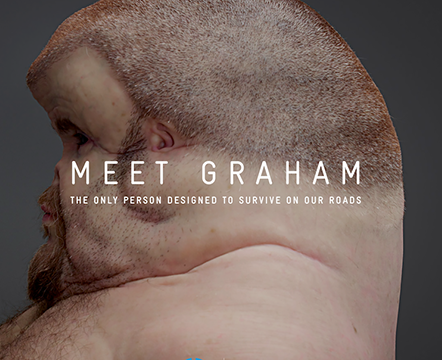
Meet Graham
Graham is a lifelike figure depicting what we might look like if we were built to survive on our roads.
Meet Graham
Graham is a lifelike figure depicting what we might look like if we were built to survive on our roads.